In the middle of Abu Dhabi’s desert stands a township that symbolizes both ambition and responsibility, Masdar City. Conceived in 2006, it is more than just an urban development; it is an experiment, a business hub, and a sustainability model for the future. Designed to minimize carbon emissions and maximize innovation, the eco-city has become a global symbol of how cities can grow without compromising the environment.
Vision Behind Masdar City
The green development was established by the Abu Dhabi government with a clear mission:
- Support clean energy solutions.
- Encourage companies to innovate sustainably.
- Build a community with minimal environmental impact.
Its vision is not only to serve the United Arab Emirates (UAE) but to inspire cities worldwide. By blending commerce and ecology, the urban initiative acts as a real-world laboratory for testing technologies that reduce waste and conserve resources.
Business Dimension of Masdar City
A Free Zone for Enterprises
One of the strongest business attractions of Masdar Township is its free economic zone status. Companies that set up here benefit from advantages such as 100% foreign ownership, no corporate or income tax, full profit repatriation, and streamlined licensing processes. These benefits create a highly supportive environment for international startups and established firms alike. As a result, the sustainable hub has become especially appealing to businesses focused on energy, climate solutions, and advanced technologies.
Innovation and Research Ecosystem
The eco-city is also home to the Masdar Institute of Science and Technology (now part of Khalifa University), which collaborates closely with global universities and industries. This partnership builds a thriving environment where students, researchers, and companies can work together. Within this ecosystem, new technologies, such as solar panels, smart grids, and efficient cooling systems, are developed and tested. In addition, startups gain access to valuable mentorship and venture funding, helping them grow in a supportive, innovation-driven community.
Corporate Residents
A number of major international corporations have established offices and research facilities in Masdar City, further strengthening its reputation as a green business hub. Notable examples include Siemens, which built a regional headquarters with energy-efficient design; the International Renewable Energy Agency (IRENA), a key global body dedicated to advancing clean energy; and Honeywell, which focuses on developing advanced energy management systems. The presence of such organizations highlights the model city’s role as a center for sustainable corporate activity.
Business Opportunities Beyond Energy
While renewable energy is the foundation of Masdar Township’s vision, business opportunities extend into several other sectors. Green construction initiatives, sustainable transport solutions, artificial intelligence applications for smart city development, and circular economy enterprises that turn waste into resources are all areas of growth. These diverse opportunities position the innovation zone not only as a clean energy hub but also as a platform for a wide range of future-oriented industries.
Sustainability Dimension
Carbon-Neutral Goals
The original ambition of Masdar City was to become the world’s first zero-carbon city. Although this ambitious vision has evolved over time, the development continues to prioritize key sustainability objectives. These include reducing greenhouse gas emissions, promoting renewable power sources, and limiting reliance on fossil fuels. While achieving absolute carbon neutrality remains a challenge, the initiative demonstrates a strong commitment to minimizing its environmental footprint.
Renewable Energy Use
The sustainable hub has made significant investments in solar energy to power the city and beyond. Within the community itself, a 10-megawatt solar photovoltaic field supplies clean electricity, supported by rooftop solar panels on many buildings. Beyond its borders, the project has contributed to international renewable projects across the Middle East, Europe, and Africa. These initiatives not only showcase the commitment to clean energy but also highlight its growing influence as a global leader in sustainable power development.
Sustainable Architecture
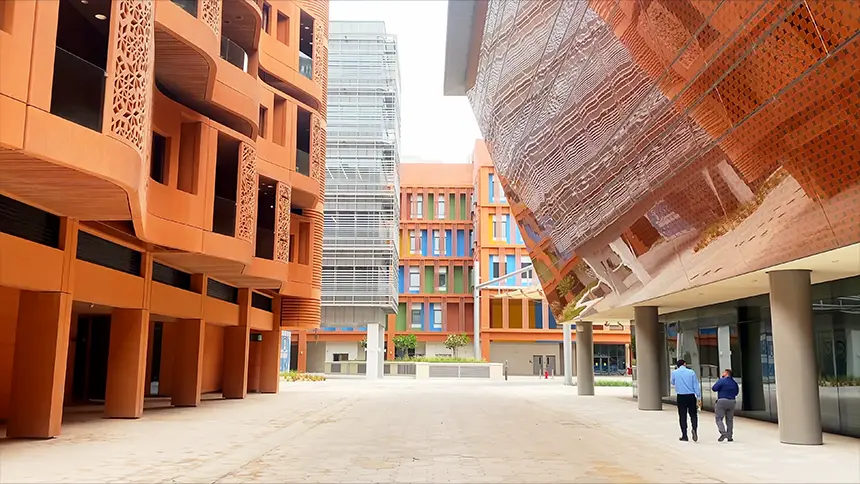
The architecture of Masdar Township reflects both modern technology and traditional design principles. Buildings are constructed to reduce energy consumption by incorporating shaded streets that help lower outdoor temperatures, while wind towers, adapted from traditional Arabic architecture, circulate cool air naturally. High-performance glass and advanced building materials further cut down on cooling demands. In addition, smart metering systems monitor electricity and water usage, encouraging residents to make efficient choices in daily life.
Waste and Water Management
An essential part of the eco-city’s sustainability strategy is efficient waste and water management. Recycling centers within the community handle both construction materials and household waste, ensuring minimal disposal in landfills. Waste-to-energy initiatives convert discarded materials into usable resources, reducing environmental strain. Advanced water treatment facilities also recycle greywater, which is then used for landscaping and irrigation. These practices collectively help conserve natural resources and support a long-term ecological balance.
Sustainable Transport
The green project seeks to minimize dependence on private cars by offering alternative transport solutions. One of its most notable features is the Personal Rapid Transit (PRT) system, which consists of driverless electric pods that reduce traffic and emissions. The city also promotes cycling and walking by designing safe, accessible pathways. To further encourage eco-friendly mobility, charging stations for electric vehicles are strategically placed, supporting a gradual shift toward clean transport.
Community Engagement
Beyond infrastructure and technology, the urban initiative’s sustainability approach also emphasizes community participation. Residents are encouraged to embrace sustainable living through awareness campaigns and lifestyle programs. The city regularly hosts major events such as Abu Dhabi Sustainability Week, which brings together global leaders, innovators, and citizens to share ideas. This culture of collaboration between individuals, businesses, and policymakers ensures that sustainability remains a shared responsibility and part of everyday life.
Challenges Faced by Masdar Township
Despite its vision, this Township has encountered obstacles.
- The original goal of a completely zero-carbon city proved too ambitious.
- Balancing the high costs of sustainable technology with economic realities is ongoing.
- Encouraging more residents to live permanently in the city remains a challenge.
- These obstacles highlight the difficulties of building an experimental city in real life.
Global Importance of Masdar City
A Role Model for Other Cities
Masdar serves as a living case study for how modern cities can evolve. Governments worldwide visit to learn about:
- Smart city infrastructure.
- Renewable energy integration.
- Green building standards.
Contribution to Climate Action
By hosting IRENA and other organizations, the eco-city plays a role in global climate negotiations and renewable energy strategies.
International Partnerships
The innovation zone partners with governments, universities, and firms from around the world. These collaborations help spread knowledge and advance technology.
Key Achievements
- Hosted the World Future Energy Summit, attracting innovators globally.
- Developed regional expertise in renewable energy.
- Attracted hundreds of companies to its free zone.
- Inspired other eco-projects in the Middle East and beyond.
- Continued investment in international solar and wind power plants.
The Future of the Masdar Township
Looking ahead, Masdar aims to:
- Expand residential communities.
- Attract more startups and global firms.
- Increase renewable energy capacity within and outside the UAE.
- Continue acting as a bridge between business and environmental responsibility.
Its ongoing growth shows that sustainable urbanism is not just a dream, it can be a living reality.
Conclusion
Masdar City is more than buildings in the desert. It is a place where business and sustainability meet. Companies come here because they find support, freedom, and opportunities. Scientists and students test new ideas. People learn how to live in a way that uses less energy and water. The project has faced challenges, but it has also taught the world that building cleaner cities is possible. Other countries look at Masdar as a guide for the future.