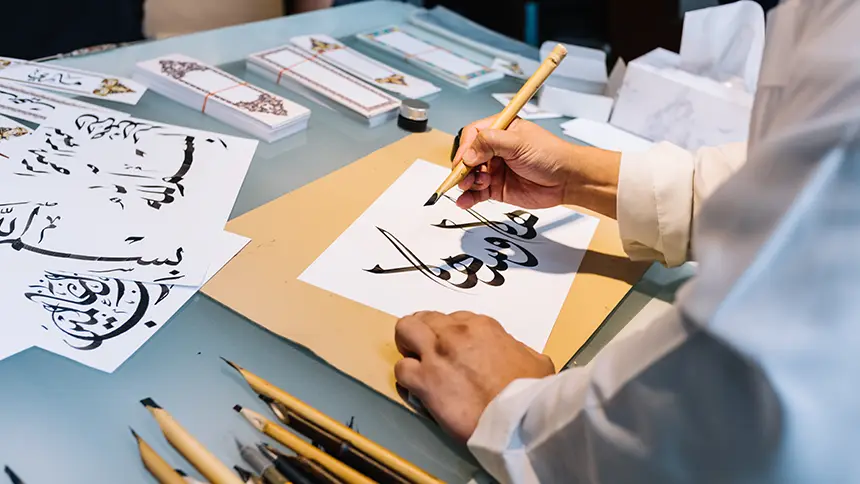
Calligraphy, the graceful art of beautiful handwriting, has a deep cultural and spiritual significance in the United Arab Emirates (UAE). It is not just about writing, it is a way of expressing identity, creativity, and devotion. The Arabic language, with its flowing letters and artistic curves, provides a perfect foundation for it to flourish.
In the UAE, calligraphy has evolved from traditional penmanship into a modern artistic movement. It appears on mosque walls, in public art installations, on luxury products, and within fine art galleries. The country celebrates this art form as part of its heritage and as a bridge between the past and the future.
Historical Background of Calligraphy
Origins in the Arab World
- The history of Arabic Scriptwork dates back to the early centuries of Islam.
- The Quran was the first major text to be written in Arabic script, inspiring artists to beautify the written word.
- As Islam spread across the Arabian Peninsula, Script art became a respected art associated with faith and education.
Arrival in the UAE Region
Before the UAE was established in 1971, the Arabian Gulf region already had a rich culture of Arabic writing. Ancient traders, scholars, and poets used beautiful scripts on manuscripts, architecture, and official documents. The UAE’s role as a center of trade helped connect artists and scholars from different Arab regions, bringing influences from Persian, Ottoman, and Maghrebi calligraphic traditions.
Influence of Religion
- The Islamic faith discouraged the use of human or animal figures in religious art.
- As a result, it became a main form of decoration in mosques and religious manuscripts.
- Verses from the Quran, prayers, and names of God were written in elegant styles to inspire spiritual reflection.
Major Styles of Arabic Calligraphy
The UAE preserves and promotes several traditional scripts, each with its own personality and rules.
Kufic Script
- One of the oldest forms of Arabic writing.
- Recognized for its angular, geometric shape.
- Commonly used in early Quran manuscripts and in architectural decorations.
- Seen today in modern logos and design projects for its bold and timeless look.
Naskh Script
- Smooth and easy to read.
- Widely used in books, newspapers, and digital texts.
- Calligraphers in the UAE still practice Naskh for religious writings due to its clarity and precision.
Thuluth Script
- Known for long, curved letters and decorative balance.
- Often used in mosque interiors, royal documents, and artistic murals.
- Requires high skill and patience; many Emirati artists use Thuluth to showcase mastery.
Diwani Script
- Elegant and flowing, developed during the Ottoman Empire.
- Popular for invitations, certificates, and official seals.
- In the UAE, it is used in cultural institutions to reflect traditional sophistication.
Ruq’ah Script
- Simple and compact style.
- Frequently used for handwriting in everyday life.
- Though not very ornamental, it is admired for its practical and clean appearance.
Calligraphy as a Cultural Symbol in the UAE
A Link Between Heritage and Modern Identity
The UAE views calligraphy as a bridge connecting ancient tradition with present-day progress. The nation invests in preserving old forms while encouraging new interpretations. This dual approach reflects the UAE’s broader philosophy, honoring roots while embracing innovation.
Presence in Everyday Life
Arabic script art is seen everywhere in the UAE, from mosque walls and government buildings to museums, public art, and modern fashion. It adds beauty to cities and connects traditional culture with contemporary design.
Emirates as a Regional Hub
Cities such as Sharjah and Dubai have become major centers for calligraphic arts. Sharjah, often called the “Cultural Capital of the Arab World,” hosts annual exhibitions and workshops that attract global attention. These initiatives help young people discover their roots and build creative careers.
Leading Emirati Calligraphers and Artists
The UAE is home to talented calligraphers who bring new life to this classical art. Some combine it with painting, sculpture, or digital design to create innovative works.
Prominent Figures
- Mohammed Mandi – One of the UAE’s most respected calligraphers, known for designing the country’s official passports and many mosque inscriptions.
- Fatma Lootah – An artist blending modern themes with Arabic calligraphy, merging contemporary painting with script.
- Abdul Qader Al Rais – Famous for abstract art that integrates Arabic letters into colorful landscapes, showing harmony between tradition and modernity.
These artists not only preserve the essence of Arabic writing but also push its boundaries into new artistic directions.
Architecture and Urban Design
Mosques and Religious Buildings
It remains a key element of Islamic architecture. In the UAE, mosques feature stunning inscriptions in gold, marble, or mosaic tiles. Examples include:
- Sheikh Zayed Grand Mosque (Abu Dhabi): Features Quranic verses in Thuluth and Kufi styles carved in marble and glass.
- Al Noor Mosque (Sharjah): Combines geometric calligraphy patterns with elegant lighting.
Public Installations
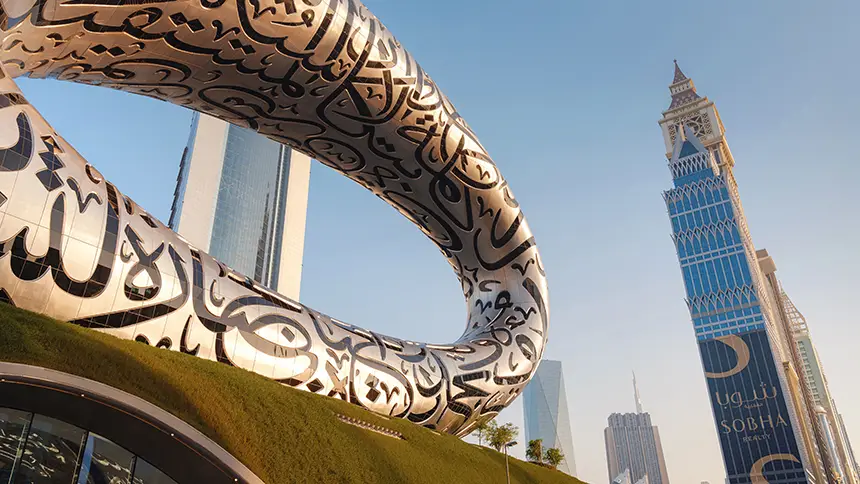
Modern architects in the UAE often include calligraphic designs in public spaces, using Arabic words in steel sculptures, engraved walls, and light projections during celebrations. These artistic features connect modern surroundings with the nation’s rich cultural identity.
Education and Training
Learning Centers and Institutes
Several educational institutions in the UAE offer training for aspiring calligraphers.
- Sharjah Calligraphy Museum: Offers classes, exhibitions, and interactive experiences for students.
- Emirates Society of Arabic Calligraphy: Promotes study programs, competitions, and mentorship for young artists.
- Private Art Academies: Provide short courses focusing on handwriting techniques and creative expression.
Workshops and Competitions
Events like the Sharjah Calligraphy Biennial and Dubai Calligraphy Exhibition bring together artists from around the world to share ideas and skills. Through workshops, participants learn letter structures, use traditional tools, explore digital styles, and develop the patience needed for this art, helping preserve this art form for future generations.
Modern Interpretations and Innovations
Modern calligraphy in the UAE merges traditional skills with technological innovation. Digital tools enable artists to create dynamic compositions on tablets, while 3D printing produces sculptures and installations, and augmented reality brings Arabic letters to life interactively. The UAE’s tech-focused environment supports these creative expansions, blending heritage with modern vision. Young Emirati artists explore abstract and conceptual approaches, combining Arabic letters with contemporary colors, textures, and multimedia, presenting handwriting art as a global visual language. Additionally, it is widely used in branding and media, from logos to luxury products, connecting modern design with cultural pride and identity.
Preservation Efforts and Cultural Initiatives
The UAE is deeply committed to preserving its cultural heritage, with calligraphy receiving strong national and institutional support. Government initiatives fund research, document traditional scripts, and showcase manuscripts in museums. In 2021, UNESCO recognized Arabic calligraphy as part of the world’s Intangible Cultural Heritage, highlighting its global value.
Community efforts also play a vital role in keeping the art alive. Schools include Lettering in their curriculum, libraries host exhibitions to promote awareness, and artists collaborate with craftspeople to weave calligraphic designs into ceramics, textiles, and woodwork, ensuring its continued relevance for future generations.
Conclusion
Lettering in the UAE stands as a powerful reminder of how tradition and creativity can coexist. From mosque walls to modern galleries, from handmade scripts to digital animations, Arabic calligraphy continues to inspire admiration and pride.
It reflects the UAE’s journey, respecting its past, celebrating beauty, and looking confidently toward the future. By nurturing this art, the nation preserves a timeless language of harmony, faith, and expression that speaks not only to the eyes but also to the soul. In a world of constant change, the flowing lines of Arabic calligraphy remind us that beauty and meaning can live together forever in the written word.